Every business owner knows that missed calls cost money. But most don't realize just how much. Industry data shows that 62% of calls to small businesses go completely unanswered — and 80% of those callers will never leave a voicemail. They just hang up and call the next business on Google.
That means if your phone rings 50 times a day and you're missing even a third of those calls, you're losing 15+ potential customers every single day. At an average project value of $2,000-$5,000, that adds up to $30,000-$75,000 in lost revenue per month.
This is exactly why voice AI is being called the highest-ROI investment a small business can make in 2026. And the numbers back it up.

The Real Cost of Not Answering Your Phone
Let's start with the uncomfortable truth. A recent study of home service contractors found that businesses miss 60-80% of incoming customer calls. That's not a typo. The majority of calls — from people actively trying to give you money — go straight to voicemail or ring out.
Here's what happens next:
- 80% of callers won't leave a voicemail — they'll call your competitor instead
- 75% of customers will call a competitor if their call isn't answered within two rings
- 42% of small businesses lose $500+ per month just from missed calls — and that's a conservative estimate
How Voice AI Changes the Math
An AI receptionist like RevSquared answers every single call on the first ring. 24 hours a day. 7 days a week. No hold music, no voicemail, no "we'll call you back." The AI picks up, has a natural conversation, qualifies the lead, books the appointment, and logs everything to your CRM — all in real time.
Here's what that looks like in practice:
A roofing contractor went from missing 64 calls per month to capturing all but 2 after deploying voice AI. Those 62 additional conversations turned into 8 additional quotes and 2 additional closed projects — a monthly revenue increase of $36,000 at a cost of $199/month.
That's a 180X return on investment from a single change.
Breaking Down the ROI Formula
The ROI calculation for voice AI is straightforward:
Step 1: Count Your Missed Calls
Most businesses miss 30-50% of inbound calls. If you're getting 100 calls per month, that's 30-50 missed opportunities. Check your phone system analytics or ask your carrier for a call report.Step 2: Estimate the Revenue Per Call
What's the average value of a new customer? For most service businesses, it's between $1,500 and $10,000. Even if only 15-20% of missed calls would have converted, the numbers are significant.Step 3: Calculate Lost Revenue
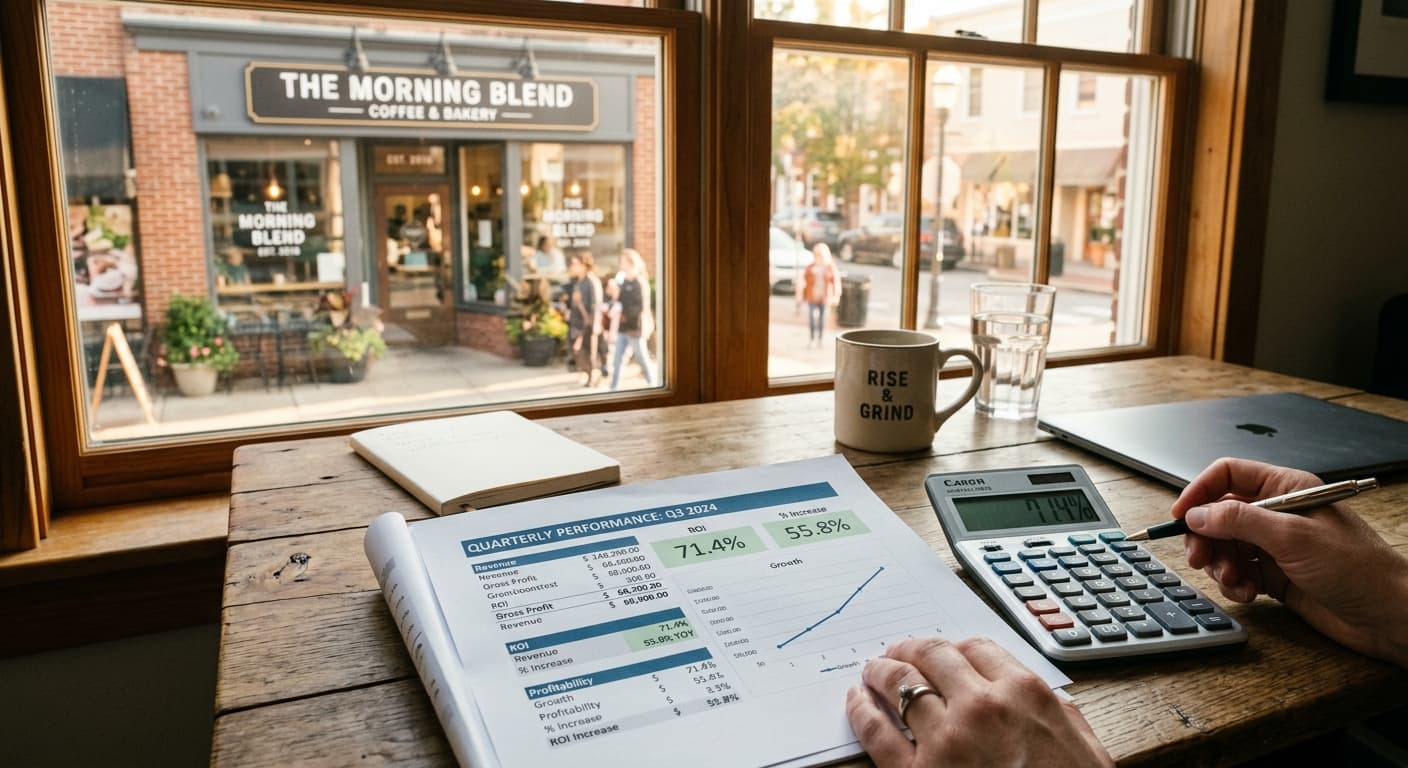
Missed calls × conversion rate × average project value = lost revenueUsing conservative numbers: 30 missed calls × 20% conversion × $3,500 average = $21,000/month lost
Step 4: Compare to AI Cost
RevSquared starts at $147/month with per-minute rates as low as $0.20/min. Even at heavy usage, most small businesses spend $150-$300/month total.$21,000 recovered revenue ÷ $200 AI cost = 105X ROI
That's not a theoretical number. That's the math for a business that was already getting calls but just wasn't answering them.
Why 2026 Is the Tipping Point
The voice AI market has hit $22.5 billion in 2026, and Gartner forecasts $80 billion in contact center labor cost savings this year alone. But the real story isn't the market size — it's what's changed about the technology:
Agentic voice AI is the biggest shift. Today's AI receptionists don't just answer questions — they execute entire workflows autonomously. They book appointments, update CRMs, route urgent calls, send follow-up texts, and qualify leads without any human involvement. One in ten customer service interactions is now fully automated by agentic AI.
Emotional intelligence has arrived. The emotional AI market has grown to $37.1 billion, and modern voice agents can detect frustration, urgency, and hesitation in a caller's voice — adjusting their tone and approach in real time. This means callers get a more empathetic experience than they'd get from a rushed human receptionist juggling three tasks at once.
Self-learning capabilities mean your AI gets better with every call. Platforms like RevSquared use conversation data to automatically refine responses, improve objection handling, and optimize booking rates — without you lifting a finger.
Voice AI vs. Hiring a Receptionist
Let's compare the all-in cost:
| Human Receptionist | AI Receptionist | |
|---|---|---|
| Monthly cost | $2,900+ (salary alone) | $147-$300/month |
| Annual cost | $35,000+ (with benefits) | $1,764-$3,600/year |
| Hours covered | 40 hrs/week | 24/7/365 |
| Calls handled | 1 at a time | Unlimited simultaneous |
| Sick days | Yes | Never |
| Training time | 2-4 weeks | 5 minutes |
| Consistency | Varies by day | Perfect every time |
| CRM logging | Manual, often forgotten | Automatic, every call |
What About the Competition?
The voice AI space has exploded in 2026. Platforms like Bland AI, Synthflow, Vapi, and Retell AI all offer voice agent infrastructure. But there's a critical difference between building blocks and a finished solution.
Developer platforms like Vapi ($0.05/min + setup) and Bland AI ($0.09/min + hidden fees) require engineering teams to build and maintain voice agents. They're powerful for enterprises with dev resources, but they're not plug-and-play for a plumbing company or dental office.
No-code platforms like Synthflow start at $375/month for 2,000 minutes — nearly 4X the cost of RevSquared for comparable usage.
RevSquared is purpose-built for small and mid-size businesses: $147/month starting price, 5-minute setup, self-learning AI that improves automatically, voice cloning for brand consistency, and CRM + calendar integrations included at no extra cost. No engineering team needed. No $2,000 integration fees. No annual contracts.
If you want a deeper comparison, check out our breakdowns of RevSquared vs Smith.ai and RevSquared vs Hey Rosie.
Five Industries Seeing the Biggest Returns
1. Home Services (HVAC, Plumbing, Roofing)
Contractors miss 60-80% of calls and the average job is $2,000-$15,000. Capturing even 5 extra jobs per month at $4,000 each means $20,000 in additional revenue — a 100X+ return on a $199/month investment.2. Dental and Medical Offices
Appointment no-shows cost the average dental practice $150,000/year. AI receptionists reduce no-shows by confirming appointments, handling rescheduling, and filling cancellation slots automatically. Read more in our AI receptionist for dental offices guide.3. Legal Firms
Potential clients calling a law firm need immediate attention — 72% of legal consumers contact only one firm. If that call goes to voicemail, the case goes to a competitor. AI ensures every intake call is handled instantly, 24/7.4. Real Estate
Agents are constantly in showings and meetings. AI handles buyer inquiries, schedules viewings, and qualifies leads while agents focus on closing deals.5. Auto Repair Shops
Customers calling for quotes or appointments expect fast answers. AI handles scheduling, provides estimates based on common services, and keeps the shop's bays full.How to Measure Your Own ROI
Getting started takes five minutes, and measuring the impact is simple:
- Track your baseline — How many calls are you missing today? Check your phone system or use a call tracking tool for one week.
- Deploy RevSquared — Set up your AI agent with your business information, connect your calendar and CRM.
- Compare after 30 days — How many calls did the AI handle? How many appointments were booked? How many leads were captured?
- Calculate the value — Multiply new appointments by your average close rate and project value. Subtract the AI cost.
For a step-by-step walkthrough, see our guide on how to set up an AI receptionist.
The Bottom Line
Voice AI isn't experimental anymore. It's a proven revenue driver that pays for itself many times over. The businesses adopting it now aren't doing it because it's trendy — they're doing it because the ROI is undeniable.
- 62% of small business calls go unanswered — that's revenue walking out the door
- AI receptionists deliver 100X+ ROI for most service businesses
- $147/month vs. $35,000/year for a human receptionist — with better coverage
- Self-learning AI gets smarter every day — your phone answering improves automatically
Start your 7-day free trial today — 7-day free trial, live in 5 minutes.