HVAC companies have a revenue problem hiding in plain sight: the phone rings, nobody answers, and the caller books with your competitor. It happens dozens of times every week — especially during summer heatwaves and winter cold snaps when your team is already buried in service calls.
The average HVAC company misses 30-40% of inbound calls during peak season. At an average job value of $400-$800, that's thousands of dollars per week walking out the door. An AI receptionist for HVAC answers every call the moment it comes in — whether it's 2 PM on a Tuesday or 11 PM on a holiday weekend.
Why HVAC Companies Lose So Much Revenue to Missed Calls
HVAC is an inherently field-heavy business. Your best people are out on jobs, not sitting at a desk. When the phone rings, there's often nobody to pick up.
The problem compounds during your busiest periods. Summer AC calls surge when outdoor temps hit 95 degrees. Winter furnace calls spike during the first hard freeze. These are your highest-volume days — and also the days when your entire crew is already dispatched.
A few patterns that repeat across HVAC businesses:
- Technicians don't answer unknown numbers while on job sites — they're focused on the work
- After-hours calls go to voicemail, and 80% of callers don't leave messages
- Dispatch staff juggle scheduling, parts ordering, and customer service simultaneously
- A single receptionist can handle one call at a time — peak season calls don't wait
That's the HVAC revenue trap in one sentence.
How an AI Receptionist Handles HVAC Calls
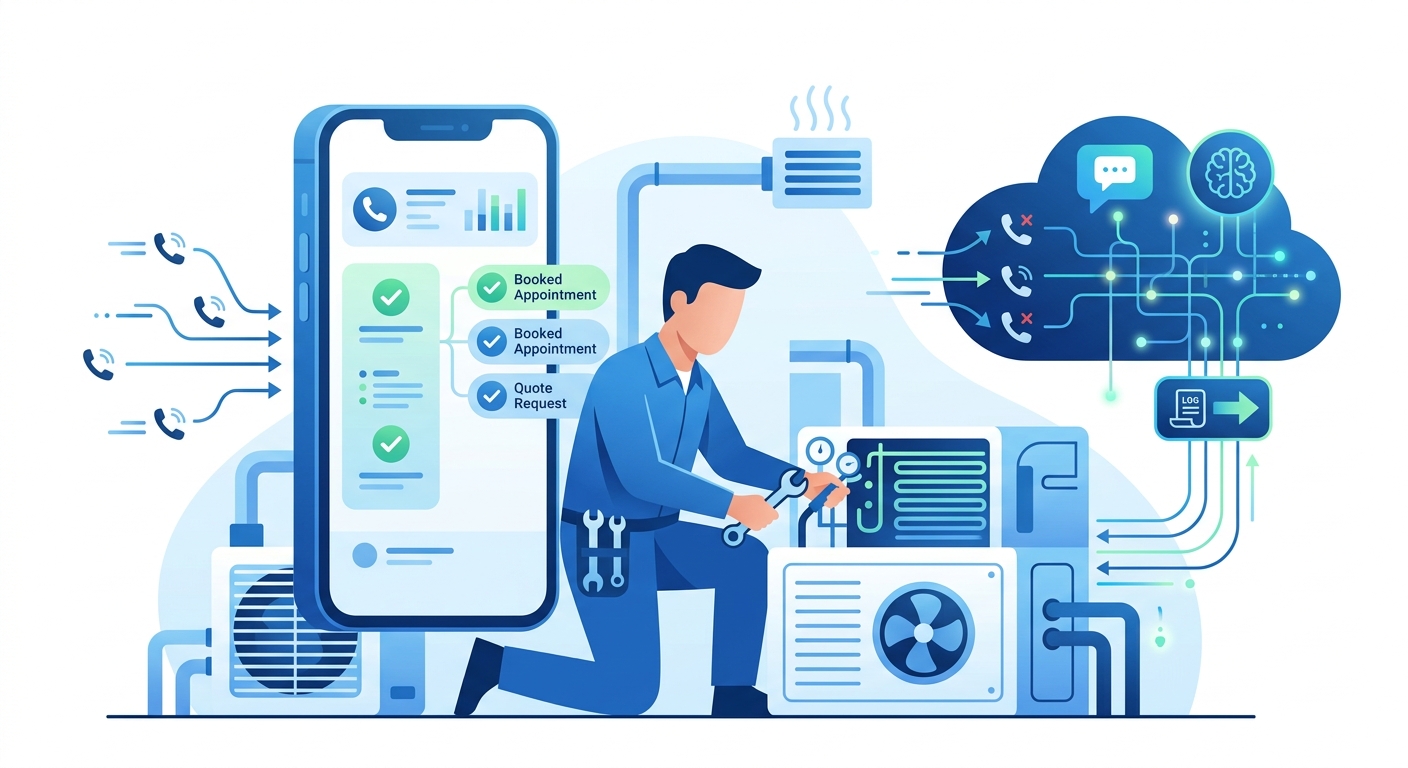
An AI receptionist for HVAC isn't a phone tree or a chatbot. It's a conversational voice AI that sounds natural, understands your business, and actually books appointments.
Here's what it handles on every call:
Emergency vs. non-emergency triage. When a caller says their furnace is out in January or their AC stopped working in August, the AI identifies it as an emergency, flags it accordingly, and routes or escalates based on your rules. No calls fall through the cracks.
Service type qualification. The AI collects the information your dispatchers need before they ever get involved: the nature of the problem, equipment type (central AC, mini-split, heat pump, gas vs. electric), the address, whether it's a new or existing customer, and their availability.
Appointment booking. Connected to your calendar, the AI books jobs directly — no hold times, no callback promises, no leads lost to "I'll call back later." Our HVAC case study showed 47 additional jobs booked in the first 30 days after deployment.
After-hours capture. A large percentage of HVAC calls come in outside business hours — evenings, weekends, and early mornings from people who noticed a problem after work. The AI handles those calls exactly the same way as business-hours calls, capturing leads that would otherwise go straight to voicemail.
Seasonal surge coverage. During peak months, when call volume doubles or triples, the AI handles up to 20 concurrent calls without degradation. No hold queues. No busy signals.
The Numbers: What Captured Calls Are Actually Worth
Let's make this concrete. Here's what the math looks like for a mid-size HVAC company:
| Metric | Without AI | With AI Receptionist |
|---|---|---|
| Daily inbound calls (peak season) | 80-100 | 80-100 |
| Calls answered | ~60 (60-75%) | ~100 (100%) |
| Missed calls per day | 25-40 | 0-2 |
| Converted to jobs (25% rate) | 6-10 | 20-25 |
| Average job value | $600 | $600 |
| Daily revenue captured | $3,600-$6,000 | $12,000-$15,000 |
The ROI case for HVAC is one of the strongest of any service industry. Calls are high-intent (the AC is broken right now), jobs are high-value ($400-$3,000+), and the competition for those calls is intense. First business to pick up often wins the job.
What HVAC Owners Get Wrong About AI Phone Agents
"My customers want to talk to a human." Most customers want their problem solved fast. If an AI answers on the first ring, gathers the information correctly, and books the appointment within 4 minutes, most callers won't care — and many won't know. A majority of callers can't reliably distinguish a well-built AI from a human receptionist when the conversation flows naturally.
"It won't understand HVAC terminology." A properly configured AI receptionist is trained on your specific services, equipment types, and service area. It knows the difference between a heat pump tune-up and a refrigerant recharge, and it asks the right qualification questions.
"We'll just hire seasonal staff." A seasonal receptionist costs $15-$20/hr, takes 1-2 weeks to train, and still can't handle more than one call at a time. An AI receptionist is live in 5 minutes, costs $147-$497/month, and handles 20 calls simultaneously.
"We already have an answering service." Traditional answering services take messages. They don't book appointments, qualify leads, or integrate with your CRM. And they charge $200-$400/month for a fraction of the capability.
HVAC-Specific Features to Look For
Not every AI receptionist is built for field service businesses. When evaluating platforms for your HVAC company, these are the capabilities that matter:
Emergency call detection. The AI should recognize urgent calls — "my heat is out," "smoke from the unit," "water leaking from the AC" — and treat them differently from routine service requests. This means immediate escalation, not a standard booking flow.
Service area qualification. Before committing dispatch resources, you want to know the caller's address is in your service area. A good AI asks for this upfront and handles out-of-area calls gracefully.
CRM and scheduling integration. The AI should write directly into your dispatch system, not generate a separate list of leads to manually re-enter. Revenue Squared AI integrates with GoHighLevel, HubSpot, Salesforce, and calendar platforms like Google Calendar and Calendly.
Call recordings and transcripts. Every conversation should be logged and searchable. When a dispute comes up about what was promised on a call, you need the transcript.
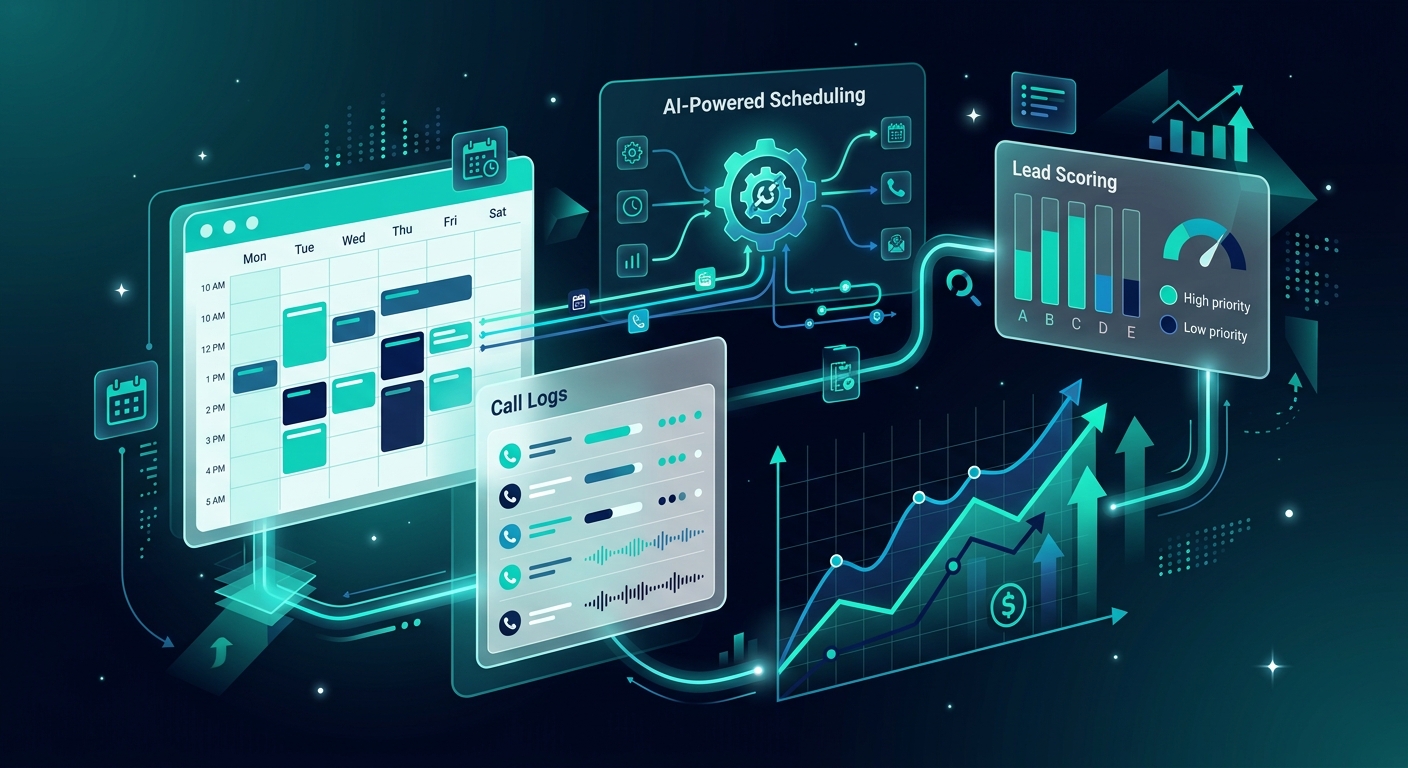
Self-improving AI. The AI Sales Manager in Revenue Squared AI's Pro plan reviews calls automatically and suggests prompt improvements — so your AI gets better at qualifying HVAC leads over time without manual intervention.
AI Receptionist vs. Hiring Another Receptionist: HVAC Cost Comparison
| Cost Factor | Human Receptionist | AI Receptionist (Rev Squared Pro) |
|---|---|---|
| Monthly cost | $3,000-$4,500 | $497/mo + $0.20/min |
| Annual cost | $36,000-$54,000 | ~$7,200-$10,000 |
| Concurrent calls | 1 | 20 |
| After-hours coverage | No (or overtime) | 24/7/365 |
| Training time | 1-2 weeks | 5 minutes |
| Scales during surges | No (fixed headcount) | Yes (automatic) |
| CRM integration | Manual entry | Automatic |
| Call recordings | No | Yes, every call |
Real Results: HVAC Company Case Study
Precision Air, an HVAC company in Phoenix, deployed Revenue Squared AI to handle overflow calls during their peak summer season. Within 30 days:
- 47 additional jobs booked that would have been missed
- $38,000 in new revenue from AI-answered calls
- 100% answer rate during peak periods
- 4.8/5 customer satisfaction on AI-handled calls
- ROI achieved within 3 days of going live
Read the full HVAC AI case study for the complete breakdown.
How to Set Up an AI Receptionist for Your HVAC Business
Setup takes under 5 minutes with Revenue Squared AI. Here's the process:
- Go to platform.revsquared.ai/agents/new and create your account
- Describe your business — service area, equipment types you service, scheduling availability, emergency vs. non-emergency rules
- Connect your calendar — Google Calendar, Calendly, or Cal.com for direct appointment booking
- Set your escalation rules — who to text or call for true emergencies after-hours
- Forward your calls — route overflow or after-hours calls to your AI agent
- Review and refine — listen to the first 10 calls, adjust the prompt as needed
If you want to compare options before committing, see our breakdown of the best AI answering services for small business or compare us directly with the best AI receptionist platforms for 2026.
The Bottom Line
HVAC companies are uniquely exposed to missed call revenue loss — field-heavy operations, extreme seasonality, and high job values make every unanswered call expensive. An AI receptionist solves this problem at a fraction of the cost of additional staff, and it works 24/7 without sick days, overtime, or hold queues.
Revenue Squared AI is built specifically for service businesses like HVAC. Configure it in 5 minutes, connect your calendar, and stop losing $50,000+ per year to calls that go unanswered.
Frequently Asked Questions
How much does an AI receptionist cost for an HVAC company?
Revenue Squared AI starts at $147/month plus $0.25/minute for the Starter plan, which includes one AI agent, appointment scheduling, call recordings, and lead scoring. The Pro plan is $497/month plus $0.20/minute and adds up to 3 agents, AI Sales Manager, voice cloning, and CRM integrations. Most HVAC companies see full ROI within the first week of deployment from captured calls alone.
Can an AI receptionist book HVAC service appointments?
Yes. Revenue Squared AI integrates directly with Google Calendar, Calendly, Cal.com, and CRM platforms like GoHighLevel. The AI collects job details, checks availability, and books the appointment during the call — no callback required. Appointment details and caller information sync automatically to your system.
Will an AI receptionist work for after-hours HVAC emergencies?
Yes. Revenue Squared AI handles calls 24/7/365. You configure your emergency rules: the AI can identify urgent calls like "no heat in winter" or "AC failure during extreme heat," collect the information, and trigger an automated alert or escalation to your on-call tech. Non-emergency after-hours calls get booked for the next available slot.
How long does it take to set up an AI receptionist for HVAC?
Under 5 minutes for initial setup. You describe your business, services, and scheduling rules in plain English — no coding, no prompt engineering. Most HVAC companies are live and taking calls the same day they sign up. Revenue Squared AI also includes Karina AI Support to help you optimize your setup based on real call data.
Can an AI handle HVAC-specific questions like equipment types and service area?
Yes. You train the AI on your specific service area, equipment types (central air, mini-splits, heat pumps, gas furnaces, etc.), and common customer questions. The AI won't guess — if a caller asks something outside its knowledge base, it collects their contact information and flags the call for follow-up. Over time, with Revenue Squared AI's self-learning capability, it improves at handling the questions your callers actually ask.